I'm not a prepper. I don't have a bunker, and I'm not stockpiling for the end of the world. But if you understand history, it's a good idea to be prepared in this climate. I watch food prices, and I grow food for a big family. Put those together and one habit makes plain sense: know how long the food in your house would last, and build a little more than you think you need.
So I built a planner to answer one question for any household: how long would your food last? It's free, it works on your phone, and your plan stays in your browser rather than going to a GrowSmart account or server. Open the Food Reserve Planner.
Why now: what the numbers say
This isn't about any one country or any one event. It's about a food system that is long, connected and sensitive to shocks.
- Global food commodity prices rose again. In its September 2026 report (released October 2, 2026), the UN's FAO Food Price Index stood at 136.0 points, up 5.8% from a year earlier. Wheat hit its highest level since August 2023, which the FAO tied to Black Sea shipping problems and dry weather in parts of North America. Maize reached its highest level in more than three years, on lower US yields, tighter supply from Brazil and Black Sea trade disruptions.
- Groceries keep rising in Canada. Canada's Food Price Report 2026 projected food prices up 4% to 6% this year, with a reference family of four spending about $17,572, up to $995 more than in 2025. Severe weather and energy prices are named as ongoing risks, and years of drought in Canada's main beef region have shrunk cattle herds.
- Weather is now a supply story. Both reports name weather as a driver: dry weather behind wheat, and drought in Canada's beef region behind smaller cattle herds. A bad season in one region can show up in prices far away.
None of this means shelves will go empty tomorrow. It means prices move fast and supply can wobble. A modest reserve can't prevent every disruption, but it gives a household more room to breathe when prices or routines change.
What history teaches
People have done this before, and not because they were afraid. They did it because it was sensible.
During the Second World War, Canadians grew victory gardens in backyards and vacant lots. By 1944 there were an estimated 209,200 of them, producing about 57,000 tonnes of vegetables. Those gardens added to household food supplies and eased pressure on the wider food system during the war.
Many of us also remember spring 2020, when flour, yeast and canned goods disappeared from shelves for weeks. Most of it was a rush of buying, plus a few bottlenecks in packaging and processing that took weeks to clear. Households that already had staples on hand were better placed to wait it out.
The lesson from both: a pantry and a garden are not panic. They are planning.
Start small: what the government recommends
The Government of Canada's Get Prepared guidance asks every household to be ready to look after itself for at least 72 hours, with about 4 litres of water per person per day. That's the floor, not the goal.
A sensible way to build an emergency food supply is one rung at a time:
- 72 hours. Water, food that needs no cooking, a manual can opener.
- Two weeks. Enough to ride out a storm, an outage or a bout of illness without a grocery run.
- One to three months. The level where a job loss or a price spike is easier to absorb.
- A season or more. Where gardeners naturally land, because the harvest does much of the work.
Pick the rung that fits your budget and space. The planner works for anything from a few days to two years or more.
How the food storage calculator works
- Add the people you feed. Daily calories fill in from Health Canada estimates by age, sex and activity, so a teenager and a toddler are not counted the same. For longer plans, the planner also estimates how children's calorie and nutrient needs change as they grow. You can type your own number if your doctor gave you one.
- Choose your timeframe. Two weeks, one month, a year, or any number of days.
- Enter what you already have. Rice in the cupboard, jars on the shelf, squash in the basement. Count each food in the unit you use, from kilograms or pounds to pint and quart jars, with the weight per jar set by you.
- Set your diet needs. Vegetarian, vegan, gluten-free, dairy-free, egg-free or nut-free. Those foods come off the list and the rest grows to keep you covered. You can also remove any single food you don't eat.
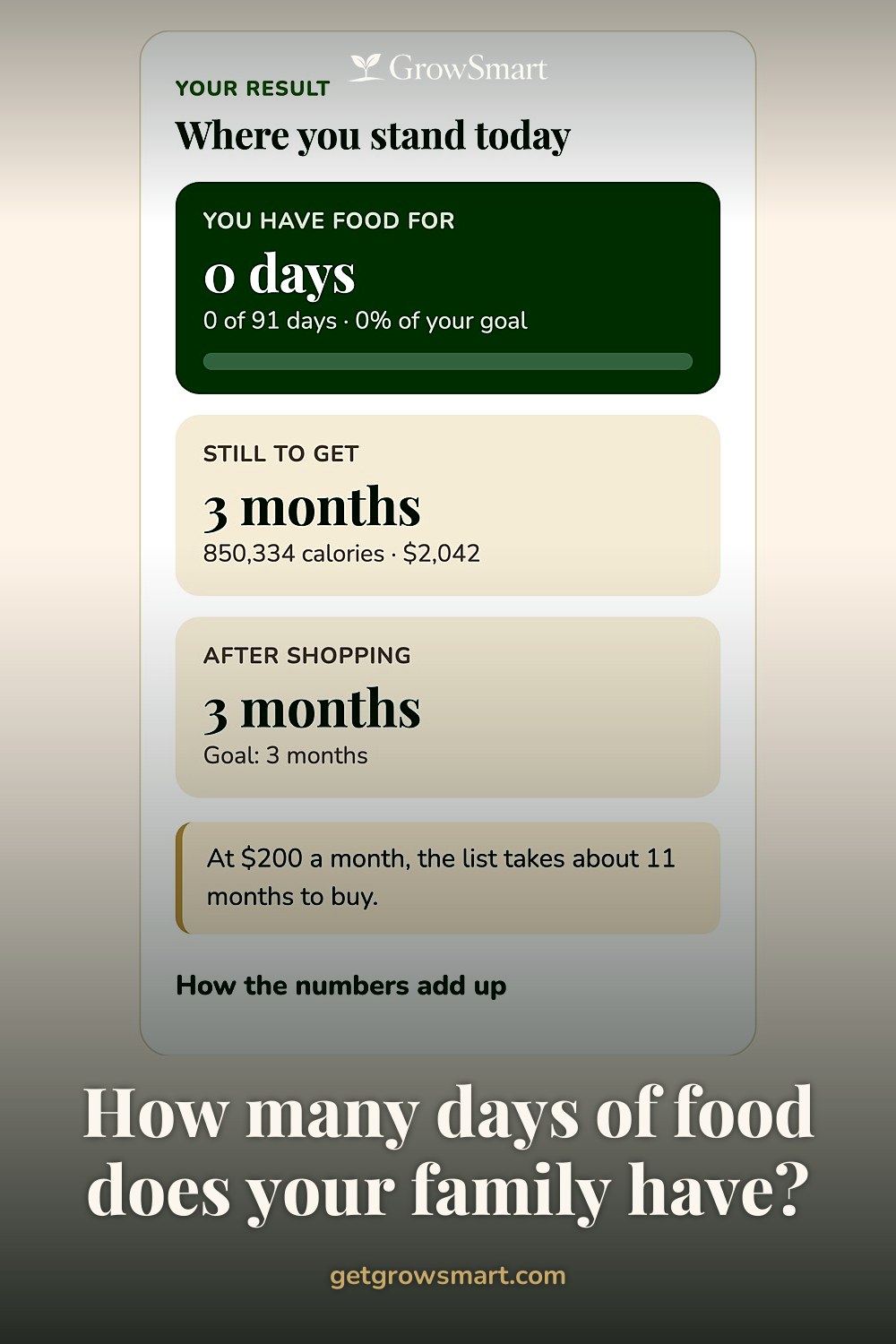
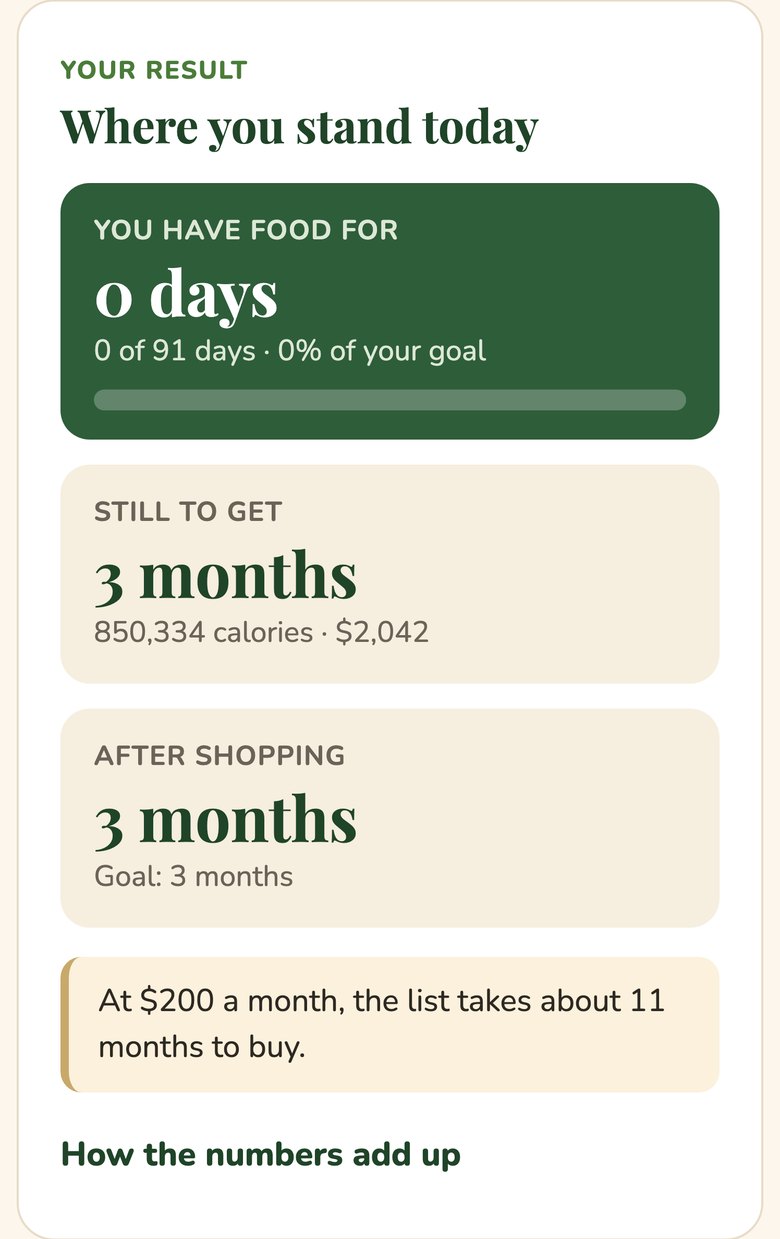
- Read your result. You see how many days of food you have, what is left to buy, what it costs, and how long your monthly budget takes to get there.
The numbers are open for you to check. The planner adds up your household's estimated calories across your timeframe, applies your safety margin, and shows how the food you have and the food you plan to buy reach your goal. What you have plus what you buy equals what you'll end up with. You can open "How the numbers add up" and check the math yourself.
Two details I care about as a gardener:
- A harvest you haven't picked yet is never counted as food you have. It shows separately as a projection, at a share you choose, because hail and blight don't read plans.
- Dates matter. Food past the date you enter drops out of your count until you check it, and food whose date falls inside your timeframe gets flagged so you eat it first. Many best-before dates are about quality, not safety, so check the food and update the date.
Calories aren't enough: the nutrition check
Rice and beans will keep you alive. They won't keep you well for long on their own.
The planner runs a quick check of six key nutrients against Health Canada's Dietary Reference Intakes for each person: protein, total fat, fibre, vitamin C, calcium and iron. It tells you plainly when a plan is short. It is a screening check, not a full diet assessment. In a pantry built mostly on grains and beans, the usual gaps are vitamin C and calcium. Canned tomatoes, canned mandarins, skim milk powder and your own preserved harvest, like home-canned passata, can help fill them. How much they help depends on how much you store.
Stored food loses some vitamin C over time, so treat a "close" result as low. The planner is a planning aid, not medical advice. If someone in your home is pregnant, has a medical condition or is under one year old, plan with a health professional.
The health side of growing your own
A reserve built partly from the garden comes with a bonus. In the first randomized trial of community gardening, published in The Lancet Planetary Health in 2023, 291 adults who had never gardened were split at random. Compared with the group asked to wait a year, those given a community garden plot ate about 1.4 more grams of fibre a day and got about 42 more minutes of moderate to vigorous activity a week. They also reported larger drops in stress and anxiety. The study covered one season in one city, so treat it as encouraging, not proof for everyone.
That matches what I see at home. The kids eat more vegetables when they picked them. The work outside does me good. And a shelf of jars in November feels like security you made with your own hands.
Store it safely
A reserve only helps if it's safe to eat.
- Keep dry goods cool, dry, dark and off the floor. Food-grade buckets or Mylar bags work well.
- Use oxygen absorbers only with truly dry foods like white rice, dry beans and pasta. Sealing moist food without air is a botulism risk, so never use them with home-dried food that still bends. Skip them for sugar and salt, which turn rock hard.
- Pressure can low-acid foods like vegetables, beans and potatoes, using a tested recipe. Don't can mashed or puréed squash or pumpkin at home. Cubes only, or cure and store squash whole.
- Use home-canned food within about a year for best quality, and throw out any jar that leaks, bulges or spurts when opened.
- Dry beans and rice need water and heat. Store water, plan a safe stove and fuel, and never run a camp stove, barbecue or generator indoors.
- Rotate: eat the oldest first and replace it. A reserve you eat from is a reserve that stays fresh.
Grow the part that refills itself
A pantry runs down. A garden fills it back up every season. That's the real reason I garden the way I do, and it's why I built GrowSmart. It plans spring, summer and fall from your own frost dates, with succession sowings and companion planting reasons built in, and the free plan covers a spring garden of 10 plants with no account needed. Summer and fall planning come with a paid plan.
Open the planner and enter what's already in your cupboards. It will show how many days that covers and what would finish the list.
Sources
- FAO Food Price Index rises in September, FAO news release, October 2, 2026
- Canada's Food Price Report 2026, Dalhousie University
- Making an emergency kit, Government of Canada (Get Prepared)
- Victory Gardens, The Canadian Encyclopedia
- Litt JS et al., community gardening randomised controlled trial (CAPS), The Lancet Planetary Health, 2023
- Dietary Reference Intakes tables, Health Canada
- How can I get the most out of my food storage, Utah State University Extension
- Tested home canning methods, National Center for Home Food Preservation